Case Study — Chapter Two
INPO
Enterprise learning delivery in a highly regulated environment — where getting documentation right meant getting a lot of people to agree on it first.
The problem
A different flavor of the same issue. Enterprise learning delivery across 30+ business units in a highly regulated environment, where content accuracy is not a quality preference but a compliance requirement and where getting documentation right meant getting a lot of people to agree on it first.
What I built
Five workstreams spanning platform, pathways, alignment, and standards.
Docebo platform administration & vendor partnership
Primary liaison with the Docebo vendor relationship, driving user-experience enhancements, automated enrollment workflows, and digital governance processes. Vendor management as an ongoing partnership with a roadmap, not a support queue.
Enrollment logic & prerequisite architecture
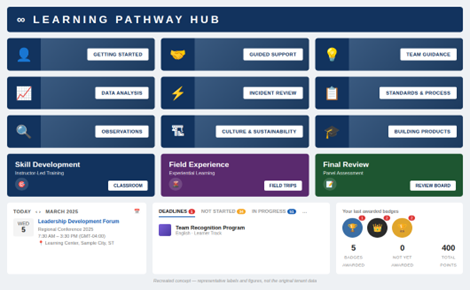
Learning pathways where completion gates access. The Copilot rollout is the clearest example: prerequisite training was structured as the unlock mechanism for license issuance, reframing compliance as access rather than obstacle.
Cross-functional documentation development
The part I am most proud of and the hardest to see. Getting content governance documentation right in a regulated, consensus-driven environment is a teaming problem before it is a writing problem — aligning departments with real, legitimate differences in what they needed the documentation to do.
Expanded platform capability
Digital badging and gamification, extending the platform beyond course delivery into recognition and sustained engagement. Badging makes capability visible across an organization — individual completion becomes something the enterprise can actually see and act on.
Content governance framework
Standards for content creation, review, and lifecycle in an environment where accuracy is regulated and version drift carries real consequence.